Sundials played an important role in early astronomy. Ancient Greek and Babylonian astronomers used sundial geometry to study the celestial sphere, measure the length of the year, and calculate equinoxes and solstices. Variations in shadow lengths at different latitudes helped early scientists conceptualize the curvature and size of the Earth.
Observatory Park currently features two sundials (The Jamestown Commemorative Sundial and the Analemmatic Sundial) and plans are underway for a model of the Ibn al-Shatir Sundial in Damascus, Syria.
The Jamestown Commemorative Sundial
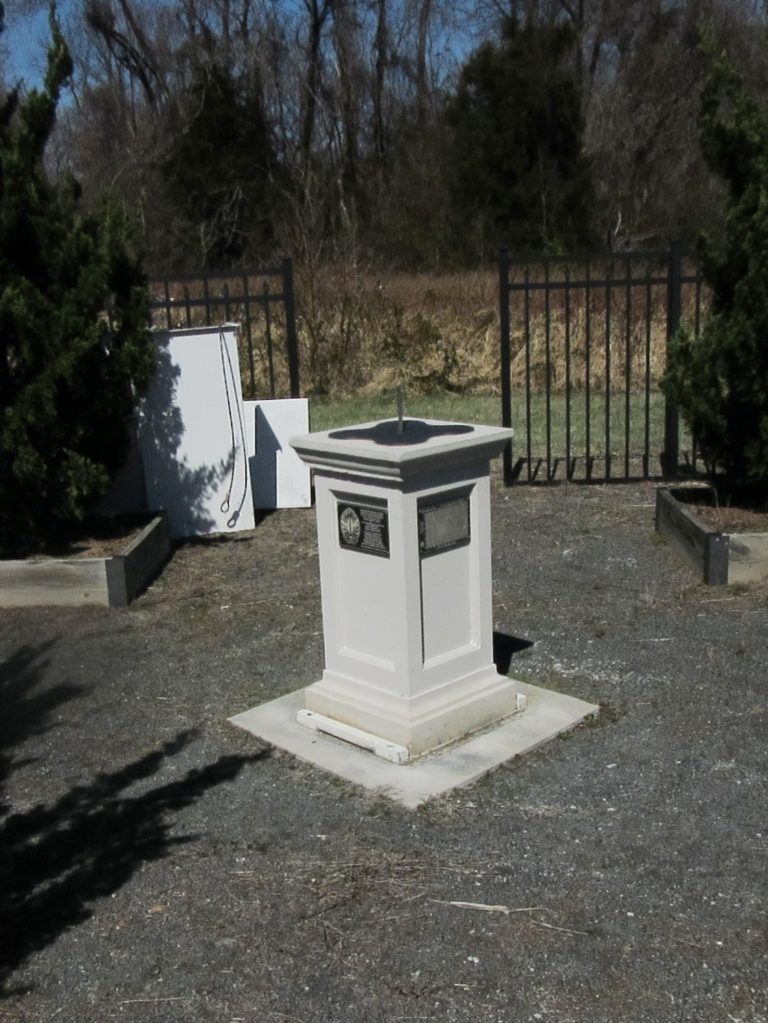
The Jamestown Commemorative Sundial was the first sundial at the Park, added to the site in 2007 to mark the 400th anniversary of the founding of Jamestown. It was crafted and designed by British sundial maker Tony Moss.
The Analemmatic Sundial
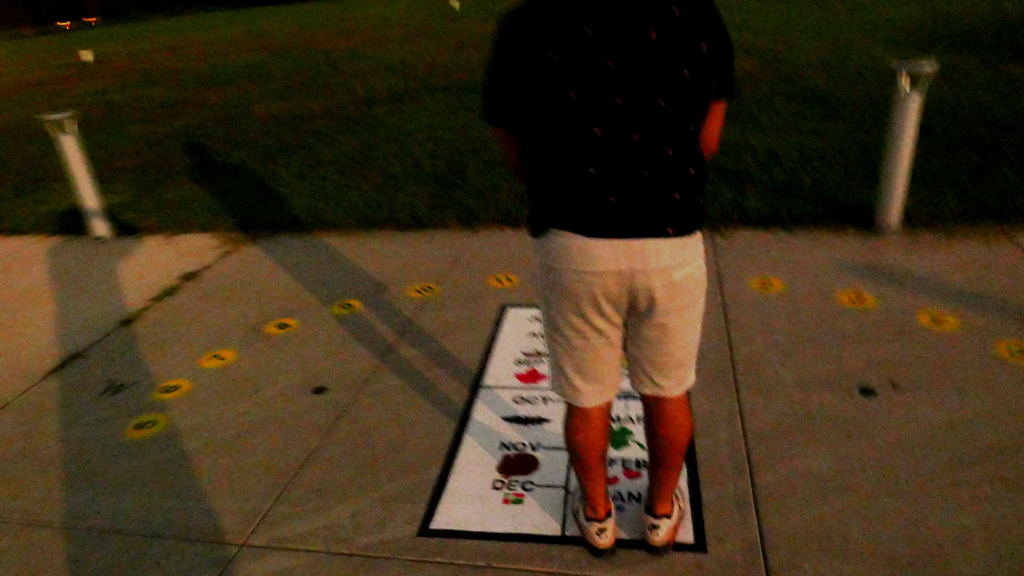
The analemmatic (human) sundial at Turner Farm Observatory Park in Great Falls, VA made by Eagle Scout candidate Kenny Dieffenderfer and Troop 1547 marked a unique place in sundialing history on July 23, 2021. The Analemma Society sponsors public viewings of the heavens through telescopes at Turner Farm's Roll-Top Observatory. But just outside the Observatory on the sidewalk is Kenny's analemmatic dial. Could this dial tell correct time by the light of the moon?
On July 23, 2021, this question was put to the test. It was almost exactly a full moon and the sky was clear. As can be seen in the accompanying photo taken by Dr. Jeff Kretsch at approximately 10:10pm EDT, the lunar shadow of a volunteer human gnomon (the part of a sundial that casts a shadow to show the time) cast a shadow of about 9:10pm standard moon civil time. How did this come about?
The important facts needed to make the analemmatic dial tell the correct "moon time" is knowing both the phase of the moon and the declination of the moon. On that night the moon was very close to being exactly a full moon and the declination of the moon was 25 degrees south of the equator. The maximum that the sun ever gets is 23.45 degrees south of the equator at the winter solstice. That means that (with practical precision) even though it was a late July night, the human gnomon must stand on the dial's zodiac walkway at the Dec-Jan winter solstice mark. The shadow is in nearly exact agreement with clock time. One might say that the moon and sun were in perfect alignment!

The Ibn al-Shatir Sundial in Damascus, Syria.
The next sundial installed at the Park will be a model of the Ibn al-Shatir sundial, which dates to AD 1371, when it was placed at the Umayyad Mosque in Damascus, Syria. It's thought to be the earliest extant sundial using a polar gnomon. This construction provides equal hours on the dial. Ibn al-Shatir is acknowledged in regard to his contributions to astronomy, which predated those of Copernicus. Read more about this sundial at https://madainproject.com/ibn_shatir_sundial.