Note: this article is being updated to make it clearer and more correct. (Oct. 2026)
an·a·lem·ma
It's the question we get asked most often! If you've never heard of it before, you're in good company!
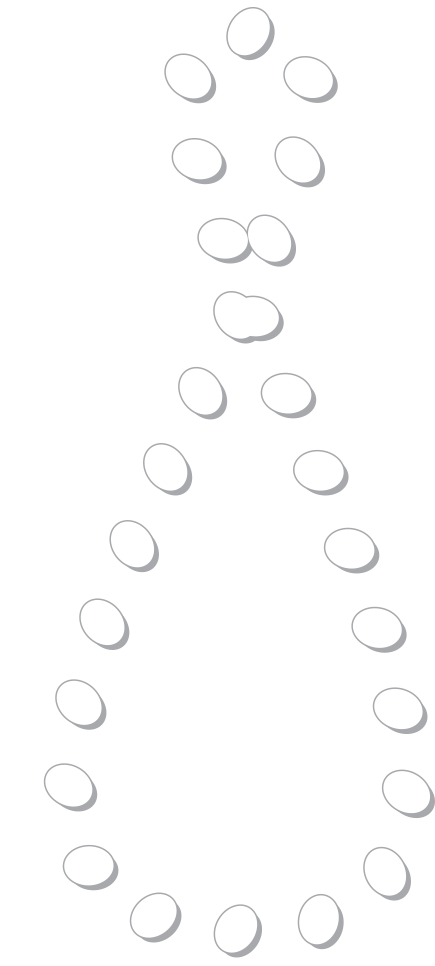
It's an old word going back to the ancient Greeks and connected to the Sun's varying position in the sky through the year. But in modern usage, an analemma is:
- The path traced out by the Sun itself through the year observed at the same time of day. (Very modern. The first time-lapse photograph was 1978-1979!)
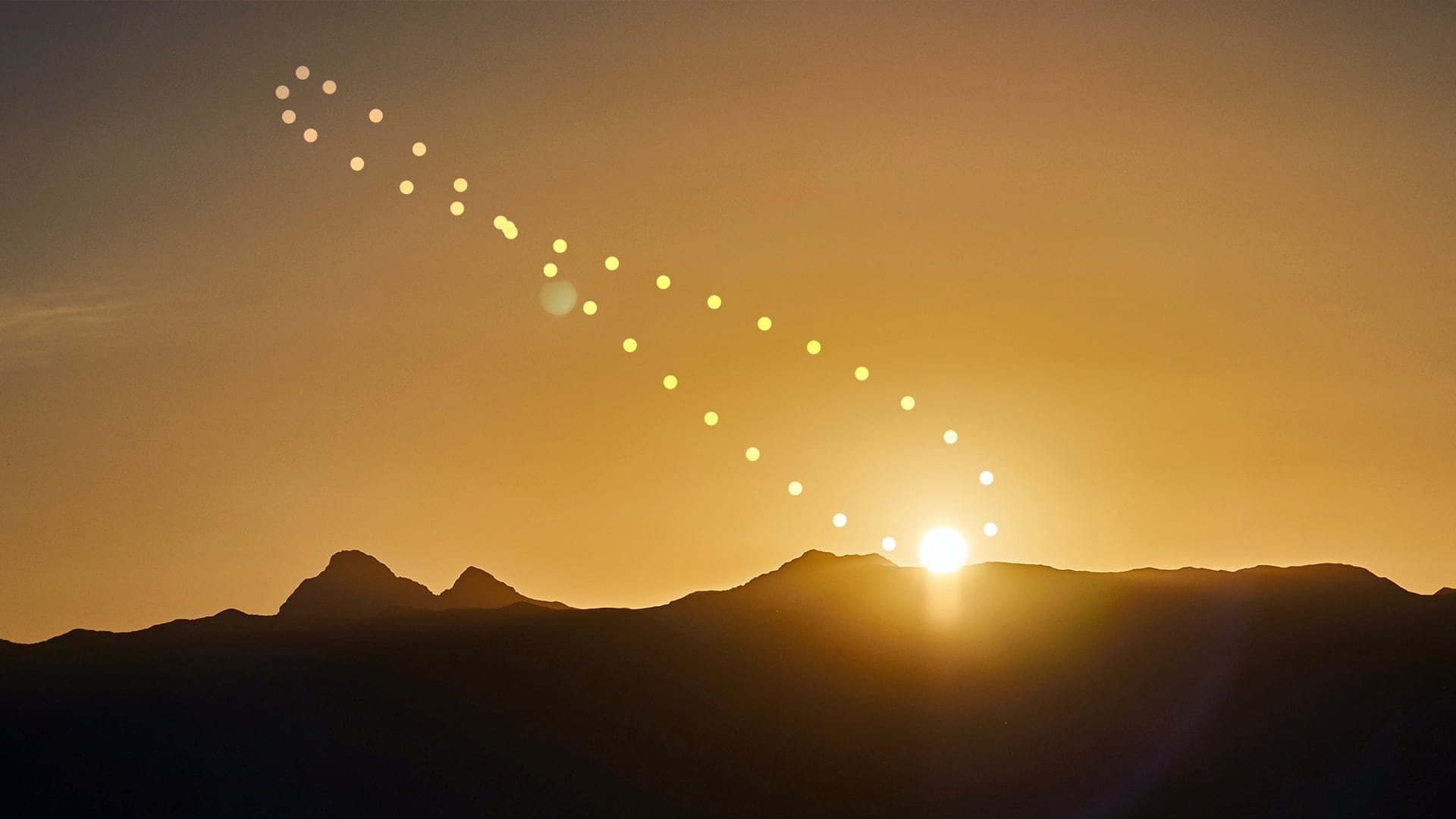
Composite photograph of the analemma, showing the Sun's figure-eight path over a year
©Vito Technology, Inc. - The path traced by a Sundial's shadow through the year, observed at the same time each day. (Really just #1 projected onto a surface.
- A curve tracing the Equation of time on the x axis and the Sun's declination on the y axis.
- The Equation of time is the varying difference between Sun-time and clock-time.
- It was known since antiquity, but only became important after accurate clocks, and especially railroads.
- The shape one can give to the gnomon (indicator) of a Sundial so the edge of its shadow shows the clock time despite the Sun's uneven motion through the year.
The word "analemma" is connected the Sun's position in the sky through the year, but the emphasis shifted as we moved timekeeping from the Sun to clocks. In (Analemmas and related lines have been etched onto sundials since at least the 18th Century to adjust solar time to clock time.)
The exact shape of an analemma varies with the location of the observer and the selected time of day. In most places on earth, it will make a figure 8
Observing the Analemma
Stand in the exact same spot every day (or week, or month)for a year. At the exact same clock time each day, photograph of the Sun (or your Sundial), ideally with a mounted camera. Overlay all 365 photographs into one image, and you won't see a single dot — you'll see a long, lopsided figure eight stretched across the sky (or Sundial). That shape is the analemma.
Why Does the Sun Draw a Figure Eight?
Briefly:
Because the Earth is tilted, and because our orbit is not a circle.
- The Earth's tilt changes the declination (up/down, or y axis).
- The elliptical orbit changes the equation of time (left/right, or x axis)
Step-by-Step:
If the Earth stood upright and didn't even orbit, then one 360º rotation would put the Sun exactly back in the same place in the sky. This would make very boring analemmas: a single dot. The dot's height would vary by latitude, but that's it.
If we let that upgright Earth orbit in a perfect circle... it doesn't help! It just takes slightly more than 360º to put the sun back in the same place, because the Earth orbited a bit overnight. But it's the same amount every day, and a day is defined by the sun, not 360º, so the analemma is the same boring dot.
But give the Earth an elliptical orbit and things become interesting! It moves faster when closer to the Sun (January), and slower when farther (July). That changing speed means the true Sun sometimes runs a little ahead of clock time and sometimes a little behind the average or mean sun. Our dot is now a horizontal line tracking the drift — astronomers call this drift the equation of time
Finally, restore the Earth's tilt (about 23.5º), and the Sun will move higher in the summer and lower in the winter. Astronomers call that a change in declination. And now our analemma will plot a two-dimensional curve that will in most places (on Earth!) will trace a figure 8.
- The tall, up-and-down stretch tracks the roughly 47º swing in the Sun's declination through the year.
- The narrow east-west drift is caused by our (slightly) elliptical orbit — it's a much smaller effect than the tilt, only a handful of degrees, yielding the wasp-waisted 8; the timing yields the lopsided, top-heavy shape — the two loops of the analemma aren't mirror images of each other, because Earth spends less time close to the sun than it does farther away.
- The 8 is also (slightly) offset left-to-right because the Earth reaches its closest point to the Sun just a couple of weeks after the December solstice, not exactly on it.
History
The earliest recorded use of "analemma" is Vitruvius AD 50, though Ptolemy's short book "On the Analemma" (~AD 150) is the canonical source. Wikipedia's excellent page summarizes:
The book "Analemma" (Greek: Περὶ ἀναλήμματος) by Ptolemy deals with the means for plotting the celestial coordinates of the Sun or any other heavenly body for any geographical latitude at any time. The construction of sundials depends on such calculations.
With the arrival of accurate clocks in the 18th to 19th Century, and especially with the advent of fast train travel causing people to adopt timezones where everyone in the zone used the average (mean) time in that zone, people needed to account for the drift between clock time and solar time. Because a sundial tracks the true Sun, it can run "fast" or "slow" compared to clock time, depending on the time of year. Sundial makers have compensated for this for centuries, often by engraving a small figure-eight correction chart — an analemma — directly onto the dial itself, so anyone reading it can adjust true solar time back into clock time.
TBD: describe our Jamestown sundial?
Other Sundials
Observatory Park has a Human Sundial painted on our main walk, built by Eagle Scout candidate Kenny Dieffenderfer and Troop 1547. It uses a human volunteer as its gnomon — with a "zodiac" track telling the person where to stand in the middle depending on the date, so their shadow will tell the time of day (and other information). However, while it is often called an "Analemmatic" sundial, it focuses mostly on the declination (height of the Sun) and mostly ignores the Equation of Time.
Not Just an Earth Thing
Any planet with both a tilted axis and a non-circular orbit will trace some version of this pattern — though the shape varies a lot from world to world, depending on how much tilt and how much orbital eccentricity each planet has. Mercury's tilt is barely there, so its analemma collapses to almost a single point. Venus and Jupiter, with fairly circular orbits, trace simple ellipses instead of figure eights. Mars, with a more elongated orbit than Earth's, draws something closer to a teardrop. Neptune, meanwhile, combines a strong axial tilt with an almost perfectly circular orbit — giving it what might be the most symmetric, textbook figure-eight analemma of any planet in the solar system.
Why Analemmas Are So Hard to Photograph
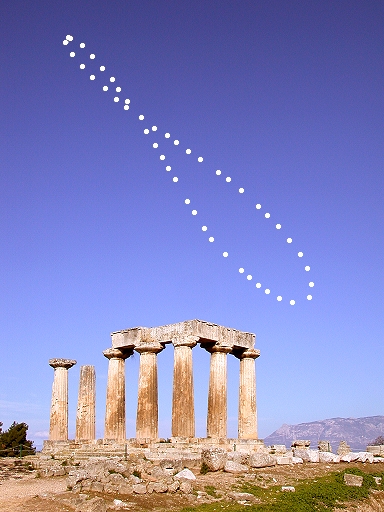
Capturing an actual photograph of an analemma is widely considered one of astrophotography's toughest long-term projects — because the full shape is never visible all at once. It only exists as a composite: 30 to 50 separate exposures of the Sun, taken at the same spot and the same clock time, spread across an entire year, layered onto one frame. One of the most striking examples comes from photographer Anthony Ayiomamitis, who spent several years photographing analemmas above ancient Greek landmarks — the Parthenon, the Temple of Zeus at Ancient Nemea, the Temple of Apollo at Ancient Corinth — using a solar filter to isolate the Sun's position on the same piece of film, visit after visit, all year long.
Plot Your Own Analemma
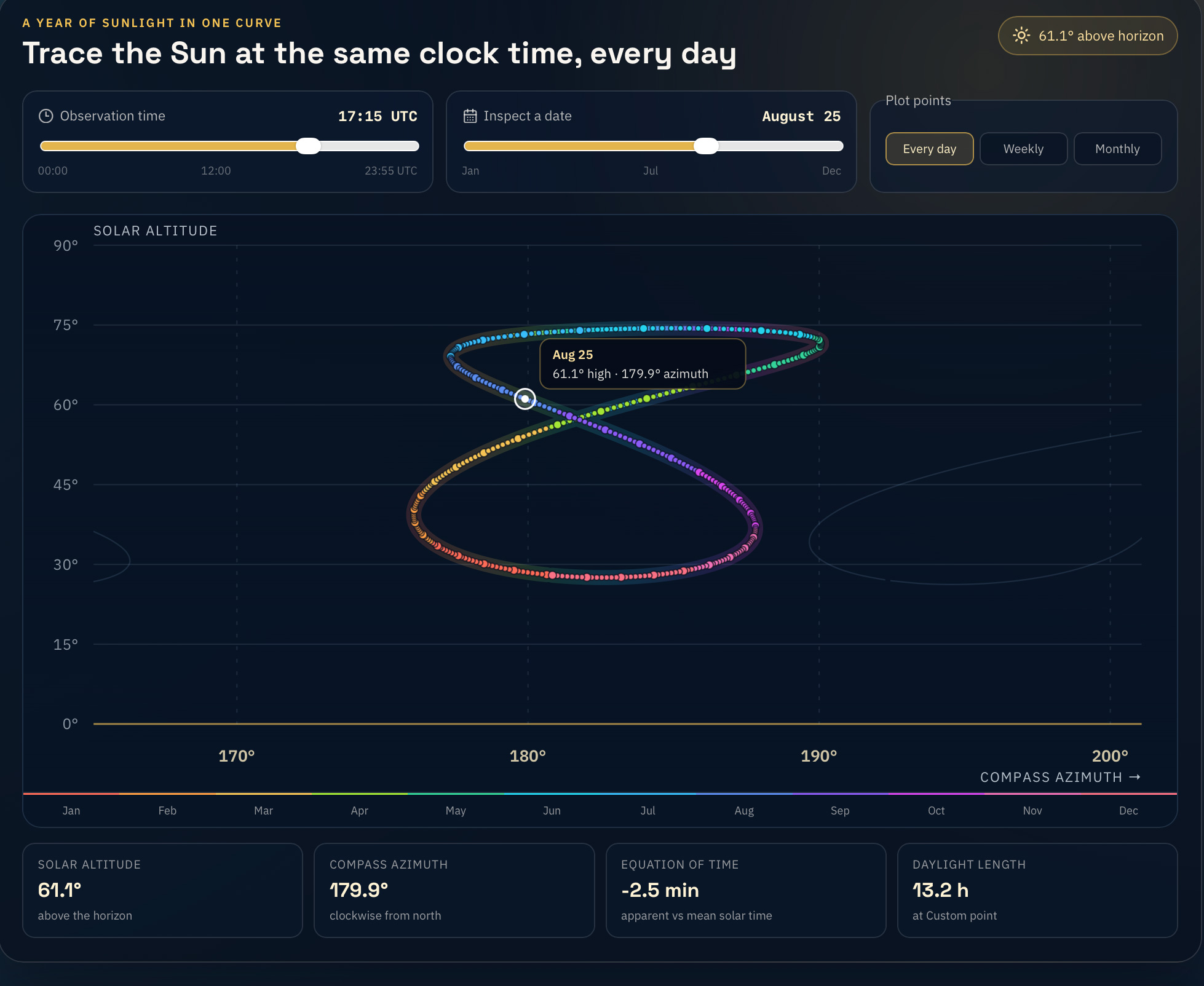
You don't have to wait a year or own a camera to see how this works. This interactive Sun analemma calculator plots the figure-eight path for any location on Earth, at any fixed UTC time, using the Sun's actual altitude and compass direction across all 365 days of the year — no camera, no year-long wait, no darkroom required. Here's what it looks like for our own coordinates at Turner Farm:
See One for Yourself
An analemma isn't something you can see in one glance — it only reveals itself over the course of a full year, one photograph at a time, from the same spot, at the same moment each day. That kind of patient, long-term observation is exactly the spirit we try to bring to everything we do at Observatory Park: astronomy as something you notice gradually, not all at once. If you'd like to see the underlying idea in action sooner than a year from now, our Analemmatic Sundial is out on the walkway anytime the park is open — and our regular public viewing nights and classes are a great place to ask questions like this one in person.
Sources:
- Merriam-Webster, analemma
- Phil Plait, “This Is Why the Sun Makes a Figure Eight in the Sky,” Scientific American, June 6, 2025
- Vito Technology, Inc., “Analemma Explained: How To Make It Easily,” Star Walk, December 2, 2023
- Stanford SOLAR Center, “Viewing and Understanding the Analemma” (photographs by Anthony Ayiomamitis)
- Sun Analemma Calculator, Runcell